4 Writing the Theoretical Framing
You have your anchor theory. You have run every other candidate through the two filters. You know what belongs in your paper and what does not. Now you have to write it.
A colleague once described writing as debugging thinking. You believe the logic is clear until you try to put it into sentences, and then you discover the gaps. The funnel structure and the paragraph rule give the debugging process a shape.
4.1 The funnel structure
A well-written theoretical framing moves from broad to narrow — from the phenomenon to the specific prediction. The reader needs to be oriented before they are asked to follow an argument.
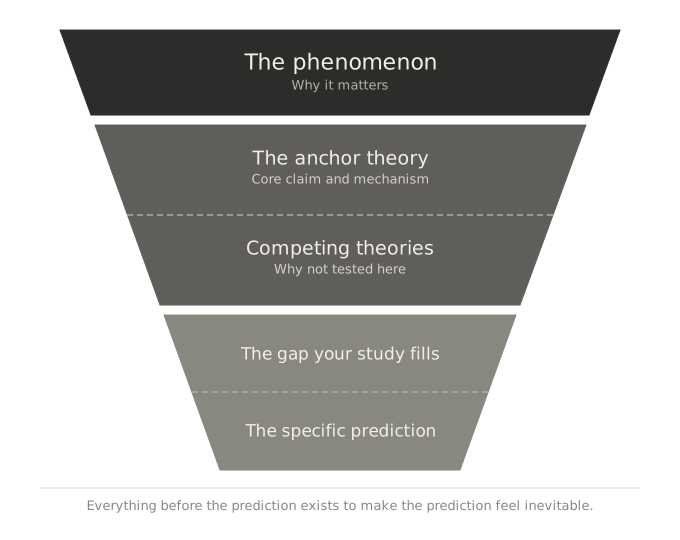
4.1.1 The funnel has five paragraph jobs.
The phenomenon. One or two sentences establishing what you are studying and why it matters. The reader should finish these sentences knowing what the paper is about.
The anchor theory. A concise statement of the theoretical account that drives your hypotheses. What does the theory claim? What mechanism does it propose? What does it predict in general? Keep this tight — two to four sentences at most. This is the lens through which your results will be interpreted.
Competing theories. Acknowledge competing accounts and explain why your study does not test them. Theories that failed F1 need only a citation; theories that passed F1 but failed F2 earn a brief explanation of why your design cannot adjudicate between them.
The gap your study fills. What does existing work leave unresolved, and why does your design address it? A clear answer here makes the specific prediction feel like a logical consequence.
The specific prediction. The narrowest point of the funnel. Given your anchor theory and your specific design, what do you predict and why? This is the payoff of the entire theoretical framing. Everything before it exists to make this prediction feel inevitable.
4.2 One paragraph, one job
Each level of the funnel corresponds to a small number of paragraph jobs. Each paragraph should have exactly one of them. State that job in a single sentence before you write the paragraph. If you cannot state it, you are not ready to write the paragraph.
| Funnel level | Paragraph job |
|---|---|
| 1. Phenomenon | Establish what you are studying and why it matters |
| 2. Anchor theory | Introduce the anchor theory and its core claim |
| 3. Competing theories | Acknowledge alternatives and explain why your design excludes them |
| 4. The Gap | State what existing work leaves unresolved |
| 5. Specific prediction | State the specific prediction that follows from the anchor theory for your study |
These are the five essential jobs. A complex anchor theory might occasionally require two paragraphs to explain, but the rule remains: one paragraph, one job. If you find yourself adding a new job that is not on this list, go back to the filters. Ask whether that paragraph is doing actual argumentative work or just adding theoretical coverage to appease reviewers.
The most common structural mistake is the omnibus paragraph — a single paragraph that introduces a theory, summarises its history, notes its limitations, compares it to alternatives, and mentions your study without connecting it to the argument. The reader finishes it without knowing what to think. One job per paragraph prevents this.
Here is one, built from the running example:
Event Segmentation Theory (Zacks et al., 2007) proposes that people segment activity into discrete events, an idea with roots in the behaviour-unit studies of the 1970s. The theory has been applied to memory, attention, and film comprehension, though it has been criticised for underspecifying how event models are represented. Situation Models offer a related account. We measured surprise ratings at boundaries and within events.
Six jobs in four sentences: the theory, its history, its applications, its critics, a competitor, and the method. None of them is finished. The history is real enough — boundary perception has been studied since Newtson & Engquist (1976) — but it is not doing a job here. Split the paragraph and the argument appears: one for the anchor and its mechanism, one for the prediction that follows. The history, the applications and the critics do not come back, because none of them changes what this study predicts.
Once you have drafted these paragraphs, the next chapter provides three structural tests to verify that the argument holds.